


Chronic graft-versus-host disease
Compliance rules
1Summary
Chronic graft-versus-host disease (GvHD) is a protracted reaction of the donor’s immune system against the recipient’s tissue. It occurs in approximately 50% of patients following allogeneic hematopoietic stem cell transplantation and typically initally appears 2 to 18 months after transplantation.
A definitive diagnosis requires clinical diagnostic symptoms or manifestations, or histological confirmation.
Treatment depends on the severity of chronic GvHD and the affected organs. It consists of topical measures and systemic administration of corticosteroids, possibly in combination with other immunosuppressants.
Severe chronic GvHD, in particular, is a contributing factor in approximately 25% of deaths following allogeneic hematopoietic stem cell transplantation.
2Basics
2.1Definition
Chronic GvHD (cGvHD) is defined as a reaction of the donor’s immune system against the recipient’s tissues, which typically develops gradually as a result of impaired tolerance mechanisms following allogeneic hematopoietic stem cell transplantation (allo-HSCT). cGvHD typically initially appears between 2 and 18 months after allo-HSCT. The most commonly affected sites are the skin, eyes, oral mucosa, salivary glands, genital mucosa, intestines, liver, fascia, or lungs. In addition, cGvHD can affect virtually any organ. Clinically, symptoms resemble those of autoimmune diseases in the rheumatic spectrum, such as scleroderma, Sjögren’s syndrome, systemic lupus erythematosus, primary biliary cholangitis, bronchiolitis obliterans, immune cytopenia, and chronic immunodeficiency. For the classification of the various forms of cGvHD, see chapter 5.3.
Overlap syndrome is a subtype of cGvHD (cGvHD with additional symptoms of acute GvHD such as nausea, vomiting, diarrhea, and diffuse erythema). It is distinguished from late acute GvHD, which is divided into 3 different subtypes. Persistent acute GvHD begins before day 100 and persists beyond that day; the de novo late form first appears after day 100; and the recurrent form of acute GvHD was initially treated successfully before day 100 and recurs after day 100. Late acute GvHD is also treated according to the guidelines for acute GvHD. The categories of acute and chronic GvHD are presented in Table 1.
2.2Epidemiology
Chronic GvHD occurs in approximately 50% of patients following allogeneic hematopoietic stem cell transplantation [1] and is a contributing factor in approximately 25% of deaths [2].While infections and acute GvHD primarily complicate the early phase following transplantation and are the main cause of early transplant-associated mortality, cGvHD represents the most significant long-term complication; severe cases also negatively impact long-term survival, whereas mild and moderate cases primarily impair quality of life. There is evidence that patients with cGvHD experience a stronger graft-versus-malignancy (GvM) effect, which reduces the likelihood of relapse of the underlying disease [3]. Therefore, mild and moderate cGvHD in particular are accepted as a means of achieving long-term disease control in patients at high risk for relapse of the underlying malignant hematologic disease. Systemic immunosuppression is indicated for moderate to severe cGvHD.
2.3Pathogenesis
The pathogenesis of cGvHD is characterized by impaired tolerance mechanisms, in which both alloreactive and autoreactive T and B cells, as well as mechanisms of chronic inflammation leading to fibrosis, play a role [4, 5]. Disruptions in donor-mediated peripheral tolerance are reflected here in particular by a relative deficiency of antigen-specific regulatory T lymphocytes. Thus, host-reactive antibodies are detectable in cGvHD [5, 8]. In addition, GvHD leads to damage to the thymus and bone marrow stroma, which impedes the generation of T and B lymphocytes and, in the case of the thymus, also promotes the formation of autoreactive T cells through impaired T-cell selection. Increased collagen synthesis has been described in sclerotic connective tissue, indicating the involvement of macrophages and fibroblasts in cGvHD.
2.4Risk Factors
The following risk factors, which increase the likelihood of developing cGvHD, have been described:
Previous acute GvHD
Degree of HLA mismatch between donor and recipient
Peripheral blood stem cells as the stem cell source compared to bone marrow
Older age of the recipient and the donor
previous infection (pneumonia, gastroenteritis, CMV reactivation)
adoptive transfer of donor lymphocytes (DLI)
Female donor for a male recipient
Omission of T-cell reduction in Graft-versus-Host Disease (GVHD) prophylaxis, particularly when using peripheral blood stem cell transplantation (ATG or post-transplant cyclophosphamide)
3[Chapter not relevant]
4Clinical characteristics
4.1Symptoms
According to the NIH consensus, a clear diagnostic manifestation or symptom must be present to diagnose cGvHD. In the absence of such a manifestation, the presence of a distinctive manifestation or symptom of cGVHD (a symptom that distinguishes between acute and chronic GVHD but is not, on its own, conclusive evidence of cGVHD—e.g., sicca syndrome affecting the eyes and/or oral mucosa) is required; in such cases, additional diagnostic measures, such as histological confirmation of the diagnosis, are necessary. In addition to the classic organ manifestations of cGvHD, atypical manifestations may also occur in other organs, which frequently present with symptoms of known autoimmune diseases (immune thrombocytopenia, autoimmune pancreatitis) [9]. The following manifestations have been defined; see Table 2:
5Diagnosis
5.1[Chapter not relevant]
5.2Diagnostics
5.2.1Initial Diagnosis
The NIH Consensus Criteria define 8 organ systems that are frequently affected [10], and to identify all of these organ manifestations, a detailed medical history and physical examination should be performed, including the following assessments [11]; see Table 3:
Since cutaneous and mucosal cGvHD is a risk factor for the development of squamous cell carcinomas, histological evaluation should always be performed if malignant changes are suspected. Furthermore, patients who have undergone allogeneic stem cell transplantation should be referred to skin cancer screening once a year. If the oral mucosa is affected, an annual follow-up with an oral and maxillofacial surgeon is necessary.
5.2.1.1Assessment of the Severity of Organ Manifestations of Chronic GvHD
In a follow-up conference in 2014, the NIH Consensus Group made additions and clarifications, which were subsequently published [10].
The most important organ severity grades are presented in Table 4. In clinical practice, an organ-specific assessment form for determining organ severity grades has proven effective; see Appendix: cGvHD Assessment Form.
Organ Stage | 0 | I (mild) | II (moderate) | III (severe) |
|---|---|---|---|---|
Skin
| No changes | < 18% KOF | 18–50% KOF | > 50% KOF |
| lichenoid or ichthyosis-like changes, no sclerodermiform changes | sclerodermiform changes with superficial sclerosis no “tethered skin” (folds can still be formed) | Deep sclerosis | |
Joints/fascia | No contractures | Mild stiffness of the arms and legs, mild restriction of movement without impairment of ATL* | Stiffness in the arms and legs or joint contractures or erythema due to fasciitis, moderate impairment of mobility, (mild impairment of ATL*) | Severe joint contractures with impairment of ATL* (inability to tie shoes, unbutton buttons, or get dressed) |
Genital tract (male) | No changes or minimal nonspecific changes | Erythema of the glans penis, “lichen planus-like” symptoms | Erythema of the glans penis and erosions, “lichen planus-like” symptoms | Urethral stenosis, phimosis |
Genital tract (female) | No symptoms, no changes, or minimal nonspecific, changes | Symptoms with mild, typical changes but no effect on sexual intercourse and minimal discomfort during gynecological examination | Symptoms with typical changes and pain during intercourse or gynecological examination | Symptoms with severe typical changes (strictures, labial adhesions, severe ulcerations, insertion of the speculum not possible) |
Oral mucosa | No symptoms, no changes, or minimal nonspecific changes | Mild symptoms with typical changes, but normal oral intake is possible | Moderate symptoms and partial restriction of oral intake | Severe symptoms with typical changes, significant limitation of oral intake |
Liver | Normal bilirubin and AP, and GPT (ALT) < 3 times the upper limit of normal | Bilirubin normal, GPT (ALT) ≥ 3 times the upper limit of normal and ≤ 5 times the upper limit of normal, and/or AP ≥ 3 times the upper limit of normal | Increased bilirubin but ≤ 3 mg/dL (51 µmol/L) or GPT > 5 times the upper limit of normal | Bilirubin > 3 mg/dL (51 µmol/L) |
Lungs** | No symptoms FEV1 > 80% | Mild symptoms (e.g., shortness of breath when climbing stairs), FEV1 60–79% | Moderate symptoms (e.g., shortness of breath when walking on level ground) and/or FEV1 40–59% | Resting dyspnea (O₂requirement) and/or FEV1 ≤39% or oxygen therapy required |
Eyes | No changes | Mild dry eyes without impairment of overall quality of life, <3 times/day eye drops, asymptomatic keratoconjunctivitis sicca | Moderate symptomatic keratoconjunctivitis, >3 times per day eye drops or tear duct occlusion without impairment of vision | Severe impairment of vision due to pseudomembranes or corneal ulcers (up to vision loss), |
Gastrointestinal tract | No symptoms | Difficulty swallowing, anorexia, nausea, vomiting, abdominal pain, diarrhea without significant weight loss and without relevant impairment (weight loss <5%) | Symptoms with weight loss of 5–15% or | Symptoms with weight loss >15% or |
** The severity of pulmonary involvement should always be assessed based on symptoms and pulmonary function tests (PFTs). In the event of a discrepancy between symptoms and PFT results, the higher of the two values should be used. The severity of pulmonary involvement should primarily be assessed using FEV1.
5.2.1.2Assessment of the Overall Severity of Chronic GvHD
The overall severity of cGVHD is assessed according to the 2005 NIH Consensus Criteria and the 2014 follow-up conference [10, 12]; see Table 5. Mild cGVHD is present when no more than 2 organs are mildly affected and no pulmonary involvement is detectable. Moderate cGVHD is present when more than 2 organs and/or at least 1 organ is affected to a moderate degree (lungs only mildly affected). Severe cGVHD is present as soon as one organ shows severe changes (Grade III) or the lungs are moderately affected.
5.3Classification
Three forms of cGvHD are distinguished:
“De novo” onset without prior acute GvHD
“Progressive” onset arising directly from acute GvHD or occurring during treatment of acute GvHD with a prednisolone dose of >0.5 mg/kg/day
“quiescent” onset following resolution of a previous episode of acute GvHD and usually after reduction of immunosuppression.
In addition to the severity of cGvHD manifestations and the progressive onset of cGvHD, the presence of thrombocytopenia (<100 × 10⁹/L) at diagnosis has prognostic significance and is associated with an increased mortality of 10% [13]. When acute and cGvHD occur simultaneously, this is referred to as “overlap syndrome,” which is a subtype of cGvHD. Overlap syndrome is particularly present when, in addition to distinctive or diagnostic signs of cGvHD, diarrhea, vomiting, or nausea occur, or when there is diffuse erythema of the skin.
6Treatment
6.1Treatment structure
Treatment of mild cGvHD is guided by the patient’s level of distress, the risk of recurrence of the underlying disease, and previous experience with the clinical course, and should be symptom-oriented, either topically or with low-dose steroids. An exception is made for patients with a non-malignant underlying disease, for whom the indication for systemic immunosuppression should be applied more broadly (graft-versus-leukemia effect is not relevant).
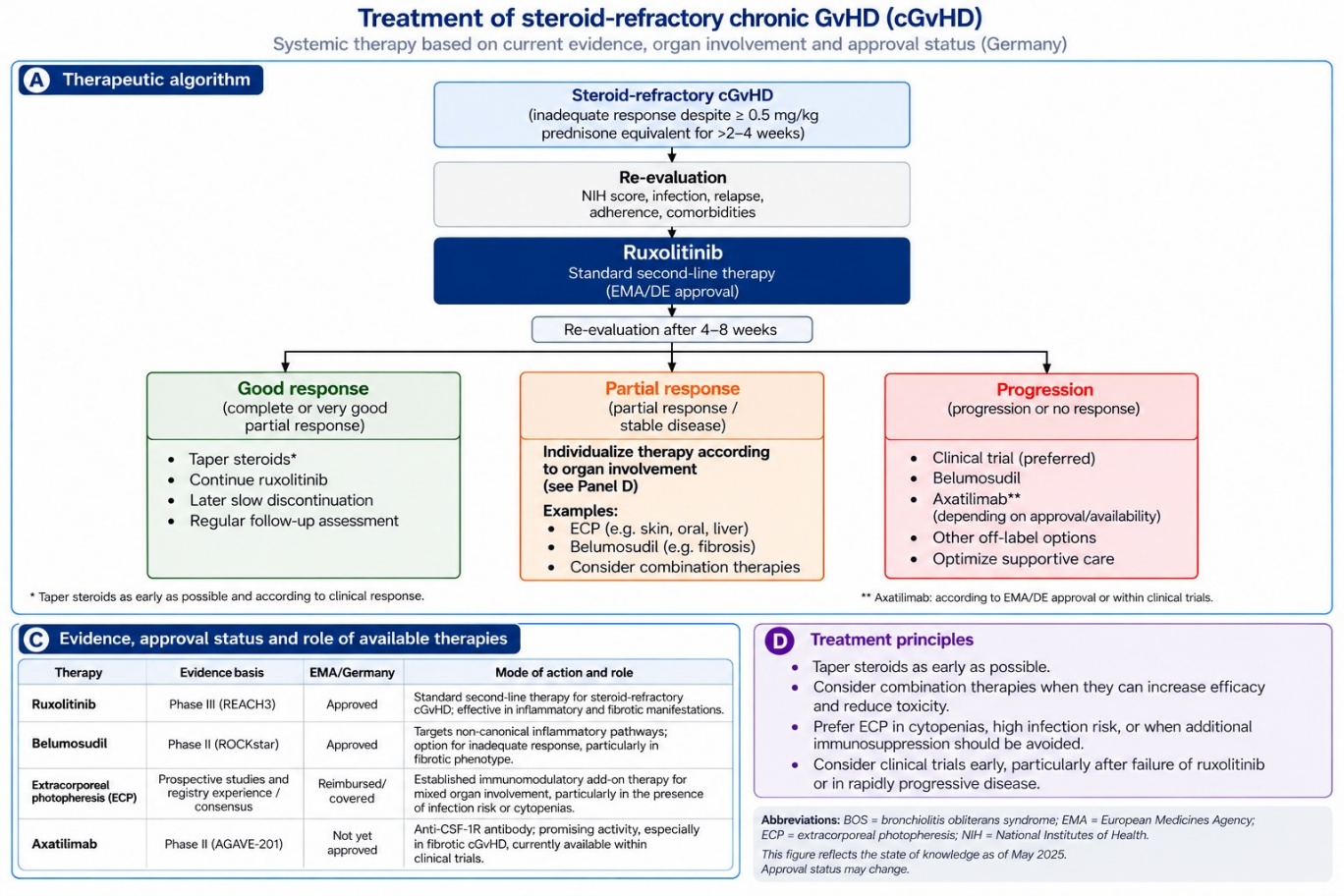
The use of corticosteroids forms the basis of first-line therapy for moderate and severe cGvHD, leading to improvement in half of the patients. For patients with high-risk cGVHD (thrombocytopenia < 100/nl, overlap syndrome, pulmonary involvement), combination therapy (on-label with calcineurin inhibitors, off-label with mTOR inhibitors or rituximab) should be considered. Patients who are already receiving steroids >0.5 mg/kg at the onset of cGvHD due to aGvHD should primarily be treated with a combination including ruxolitinib (effectively second-line therapy). If cGvHD develops while the patient is being treated for aGvHD with steroids and ruxolitinib, the criteria for third-line therapy for cGvHD apply. The choice of therapeutic option is based on evidence, the spectrum of side effects, the severity of GvHD, the risk of recurrence, comorbidities, and availability. In general, it should be noted that the use of most immunosuppressants is associated with an increased susceptibility to infection, drug-specific side effects, and a potential reduction in the desired antitumor effect. Therapeutic options with no or only a slight increase in the risk of recurrence of the underlying disease include extracorporeal photopheresis (ECP), mTOR inhibitors, and topical therapies.
This figure reflects the state of knowledge as of May 2025.
6.1.1First-line therapy
In cases of mild cGvHD, topical therapy should be administered; if this is not possible, systemic therapy with a low-dose steroid (prednisolone or methylprednisolone) once daily in the morning should be used [14].
6.1.1.1Systemic therapy
In cases of moderate or severe cGvHD, systemic immunosuppression with a corticosteroid (prednisolone or methylprednisolone 1 mg/kg/day as a single dose in the morning) is necessary (Table 6). Particularly in cases of severe cGvHD, primary combination immunosuppression should also be considered to reduce steroid use in the medium to long term [15]. Both cyclosporine (target level 100–150 ng/mL) and tacrolimus (target level 4–6 ng/mL) can be used for this purpose. In a prospective, randomized pilot study, the use of ECP in combination with standard therapy consisting of a calcineurin inhibitor (cyclosporine or tacrolimus) and a corticosteroid in patients with newly diagnosed moderate or severe cGvHD showed high response rates of 74% at week 28 [16].
Combination therapy with more than two immunosuppressants is not indicated as first-line therapy. Topical therapy may be used as an adjunct to improve the local response. Patients with an overlap syndrome, in whom acute symptoms—particularly significant gastrointestinal symptoms (diarrhea)—predominate, should be treated according to the treatment recommendations for acute GVHD. Since, in cases of progressive cGVHD, symptoms typically begin while the patient is under significant immunosuppression, second-line therapy is generally necessary as soon as symptoms appear (see above).
In general, for cGvHD, a single dose of corticosteroids should be administered in the morning. An exception is patients with overlap syndrome, who have concurrent symptoms of both acute and chronic GvHD.
6.1.1.2Topical Therapy
The following local treatment options are available (Table 7).
6.2Second-line therapy
If symptoms progress during the first 4 weeks of first-line therapy, or if there is no improvement in symptoms within 8 to 12 weeks, second-line therapy must be initiated. Ruxolitinib is approved for this purpose in the EU. Alternatively, treatment should be administered as part of prospective clinical trials whenever possible. Even after failure of first-line therapy, the use of steroids remains important due to their broad anti-inflammatory effect. Given the numerous side effects, the primary goal should therefore be to achieve the lowest possible dose of corticosteroids through a combination of corticosteroids with another immunosuppressant and, in the event of remission of cGvHD, to discontinue corticosteroids. Regarding the choice of corticosteroid, there is no evidence of a benefit when comparing methylprednisolone, prednisone, and prednisolone, although prednisone and prednisolone were almost always used in studies on cGvHD. Given the complete lack of evidence supporting the use of dexamethasone for the treatment of cGvHD and clinical indications of reduced efficacy, it should be used only in patients with suspected CNS manifestations of GvHD.
In general, no more than three immunosuppressive drugs should be combined, as this often does not lead to improved efficacy but does result in a significantly increased risk of side effects and infection. To date, there is little evidence regarding the expected efficacy of these medications for individual patients; therefore, drug selection is primarily based on the evidence, approval status, side effect profile, and medical history. Relevant information on the available medications is summarized in Table 8. The choice of second-line therapeutic option is based on the evidence, the spectrum of side effects, the severity of cGvHD, the risk of recurrence, comorbidities, the patient’s current clinically relevant side effects, and the availability of the medication. In second-line therapy, ruxolitinib is currently approved based on the results of the REACH 3 study and is therefore the first-line treatment. If ruxolitinib is contraindicated (e.g., due to infections or cytopenia), another therapy (e.g., an ECP) should be considered based on the adverse effect profile. Starting with the third line of therapy, belumosudil is approved in the EU for the treatment of cGvHD based on the ROCKStar study (see Figure 2). It is not yet approved in Switzerland.
In general, cellular therapies should also be explored within the context of clinical trials (mesenchymal stromal cells, regulatory immune cells, CAR-T cells, etc.).
Treatment | Recommendation1 | Evidence2 | Response rate % | Adverse effects in >25% of treated patients | Comments |
|---|---|---|---|---|---|
Corticosteroids | B | III-1 | n/a [13] | Osteoporosis, osteonecrosis, infections, diabetes mellitus | Of central importance |
Ruxolitinib [17] | B | Ib | ~60 | Hematotoxicity, infections, hepatotoxicity | FDA and EMA approval for steroid-refractory cGvHD starting in the second-line setting (based on a randomized Phase III trial) |
Belumosudil [34] | C-1 | II | 65% (Best ORR) | Liver toxicity Diarrhea Infections
| EMA approval for third-line treatment of cGVHD. No direct comparison with BAT to date |
Photopheresis [18] | C-1 | II | ~ 60–70 ~ (30% CR) | Infections associated with central venous catheters | Venous access required, steroid-sparing effect, good tolerability |
mTOR inhibitors (sirolimus, everolimus) [19] | C-1 | III-1 | ~ 60 ~ (20% CR) | TAM, hyperlipidemia, hematotoxicity | Increased risk of microangiopathy when used in combination with calcineurin inhibitors; monitoring of levels is required |
Mycophenolate mofetil (MMF) [20] | C-1 | III-1 | ~ 50 ~(10% CR) | Gastrointestinal side effects, increased risk of infection (viral) and recurrence | Steroid-sparing effect |
Calcineurin inhibitors (cyclosporine, tacrolimus) [21] | C-1 | III-1 | n/a | renal toxicity, hypertension, increased risk of recurrence | Steroid-sparing effect; monitoring of drug levels required |
Ibrutinib [22] | C-1 | III-1 | ~60% | Infections Tendency to bleed (skin) | FDA approval for steroid-refractory cGvHD |
Methotrexate | C-2 | III-1 | ~50 ~(10–20% CR) | Hematotoxicity, mucositis | Option for mucocutaneous cGvHD, steroid-sparing effect; not recommended for pleural effusion, ascites, renal insufficiency, cytopenia, or oral GvHD > Grade 1 |
High-dose corticosteroids | C-2 | III-2 | 50–75 (PR3 only) | Increased risk of infection | Rapid control of cGvHD symptoms |
Thoracoabdominal radiation therapy | C-2 | III-2 | ~ 50 ~ (25% CR) | Hematotoxicity | Best results for fasciitis and mucocutaneous cGvHD |
Hydroxychloroquine | C-2 | III-2 | ~ 25 ~ (10% CR) | GI side effects | Best results for mucocutaneous and hepatic cGvHD |
Clofazimine | C-2 | III-2 | ~ 50 (PR only) | GI side effects, hyperpigmentation | Best results in mucocutaneous cGvHD |
Pentostatin | C-2 | II | ~ 50 ~ (10% CR) | Hematotoxicity, risk of infection | Best results in children |
Rituximab [24] | C-2 | II | ~ 50 ~ (10% CR) | Increased risk of infection | Effective for autoantibody-mediated manifestations |
Imatinib | C-2 | II | ~ 50 ~ (20% CR) | Fluid retention | Efficacy demonstrated primarily in sclerodermoid cGvHD and bronchiolitis obliterans |
Bortezomib [25] (Reported to date only as a first-line therapy in combination with cortisone) | C-2 | III-1 | ~ 70 10 CR (combination effect of prednisone + bortezomib) | Polyneuropathy, hematotoxicity | Particularly in cases of concurrent cGvHD and relapse in multiple myeloma |
Pomalidomide [26] | C-2 | III-1 | ~60 | Infection, fatigue | May cause cutaneous inflammation if used early after treatment |
Ixazomib [27] | C-2 | III-2 | ~40 | Hematotoxicity, gastrointestinal toxicity | |
Tocilizumab [28] | C-3 | III-3 | ~40% | Suppression of the acute-phase response | Efficacy in fibrosing mucocutaneous GVHD |
C-3 | III-2 | ~40% | Infections, intolerance | Efficacy in mucocutaneous and pulmonary cGVHD | |
Interleukin 2 [31] | C-3 | III-1 | ~ 50 (PR only) | Fever, arthralgia | In sclerodermoid cGVHD |
Cyclophosphamide [32] | C-3 | III-3 | Hematotoxicity | For the vasculitic form and/or renal involvement | |
Axatilimab [35] | C-2 | III-1 | ~70% | Increased transaminases and lipase | FDA approval for third-line treatment of cGVHD |
Azathioprine | C-3 | III-1 | n/a | Hematotoxicity, increased risk of infection | Increased risk of oral mucosal malignancies |
Retinoids | C-3 | III-2 | ~ 60 (PR only) | Skin toxicity, hyperlipidemia | Effective for sclerodermoid skin involvement |
Alemtuzumab | C-4 | III-3 | n/a | Increased risk of infection | Last resort for refractory cGVHD |
Etanercept | C-4 | III-3 | n/a | Increased risk of infection | May be used in cases of a mixed presentation of acute and chronic GVHD or gastrointestinal manifestations of chronic GVHD |
2 Evidence: III-1: multiple case reports from retrospective evaluations or small, uncontrolled clinical trials; III-2: only one retrospective, uncontrolled study or retrospective evaluation; III-3: exclusively individual case reports [33].
3 Abbreviations: CR – complete remission, n.a. – not specified, PR – partial remission
Response is assessed in the same manner as for first-line therapy; see the Appendix cGvHD Assessment Form. Medications that have proven ineffective should be discontinued accordingly; as a general rule, only one medication should be changed at a time to better assess the efficacy of the therapeutic measures implemented.
6.3Specific Treatment of Affected Organ Systems
6.3.1Oral
First, rule out infections; then start with budesonide mouthwash (if the affected area is extensive; otherwise, use triamcinolone acetonide adhesive ointment if the condition is localized; only then use tacrolimus ointment
Budesonide nasal spray
Tacrolimus monohydrate 0.1% on a gauze pad
Triamcinolone
Black tea mouthwash
Xerostomia: drink frequently, sugar-free candies, chewing gum,
Budesonide lozenges
Saliva substitute, mouthwash (contains, among other ingredients, carboxymethylcellulose)
A lack of saliva increases susceptibility to tooth decay. Regular dental checkups are recommended
Rhubarb root, salicylic acid for mucoceles
6.3.2Neuromuscular
Polyneuropathy: Carbamazepine, gabapentin, pregabalin
Muscle cramps: Try high-dose magnesium, quinine sulfate, or gamma-aminobutyric acid (GABA)
Steroid myopathy / contractures: intensive physical therapy
6.3.3Liver
Urodeoxycholic acid, dose 3 × 250 mg for cholestasis
Budesonide 3 × 3 mg (for elevated transaminases)
6.3.4Lungs
Azithromycin 250 mg 0-1-0 Mon, Wed, Fri
High-dose steroid inhalation in combination with a long-acting beta-2 agonist
Use of montelukast
Immunoglobulin replacement therapy for IgG deficiency (IgG < 4 g/L or IgG2 deficiency) and infections
Consistent immunosuppressive therapy with monitoring of lung function (preferred medications: steroids, CNI [tacrolimus], ECP, mTOR inhibitors, MMF, imatinib, abatacept, belumosudil)
If applicable, lung transplant outpatient clinic when a lung transplant is being considered. A lung transplant is only possible after 2 years of being recurrence-free from the underlying malignant disease.
Respiratory Therapy
For respiratory failure: Home oxygen therapy
6.3.5Gastrointestinal tract
Budesonide 3x3 mg
Exclusion and treatment of differential diagnoses (viral/bacterial gastroenteritis, exocrine pancreatic insufficiency)
6.3.6Eye
Use preservative-free and phosphate-free eye drops; due to the increased risk of infection, preferably in single-use vials (EDO)
Cyclosporine eye drops for long-term topical therapy
Cortisone-containing eye drops should be used only for short-term therapy under the supervision of an ophthalmologist
Always under the care of an ophthalmologist
6.3.7Genital
Women:
Care with oil-based ointments, water-based cream (may cause a burning sensation)
If necessary, local estrogen therapy—prescribed by a gynecologist
Anti-inflammatory therapy with topical steroids or calcineurin inhibitors
For stenosis: vaginal dilation, surgical removal of synechiae.
Men:
Treatment with dexpanthenol ointment, black tea compresses, topical calcineurin inhibitors—especially for erosions; use topical steroids only for a short time, ideally combined with a topical antifungal
Circumcision if necessary in cases of phimosis
6.3.8Bones
Patients with chronic GvHD have a high risk of osteoporosis and an increased risk of aseptic bone necrosis. 25OH-vitamin D supplementation is urgently required (in combination with calcium if calcium intake is insufficient).
Annual bone densitometry is recommended unless antiresorptive therapy (bisphosphonates or denosumab) is already being administered.
6.4Physical Therapy
The following supportive measures should be implemented over an extended period to improve the patient’s overall well-being:
Physical therapy for the prevention and treatment of steroid myopathy
Connective tissue techniques (following prior heat application) and manual therapy, particularly in cases of fibrotic changes
Lymphatic drainage
Respiratory therapy, reflexive breathing exercises in cases of pulmonary involvement and indurations in the trunk region
6.5Supportive care
Inhalation therapies
Antiinfectives (PjP prophylaxis is always required during immunosuppression; in addition, at least one “standby” antibiotic effective against pneumococci should be prescribed; HSV/VZV prophylaxis should be considered during the first 2 years after transplantation or in patients with a relevant medical history. Under combination immunosuppression and steroids > 0.5 mg/kg/day, prophylactic antifungal therapy effective against Aspergillus should also be considered.)
Vaccinations may be administered while on immunosuppression with controlled GVHD and steroids < 0.5 mg/kg/day. Following B-cell depletion and ibrutinib treatment, no immune response to conjugate vaccines is expected.
Skincare products
Supplemental nutrition
Psychological support for distressed patients and their families
6.6Response Assessment
Assessment of response according to the criteria listed in the cGvHD assessment form in the appendix.
7Rehabilitation
In addition to supportive physical therapy, inpatient or outpatient rehabilitation may be beneficial following management of cGvHD, with the goal of improving functional status and overall performance. Due to the immunodeficiency associated with cGvHD and the often complex medication regimen, expertise at the rehabilitation facility—including collaboration with a transplant center—is urgently required for the care of patients following allogeneic hematopoietic stem cell transplantation.
8[Chapter not relevant]
9References
Lee SJ, Vogelsang G, Flowers ME: Chronic graft-versus-host disease. Biol Blood Marrow Transplant 9:215-233, 2003. PMID:12720215
Akpek G, Zahurak ML, Piantadosi S, et al.: Development of a prognostic model for grading chronic graft-versus-host disease. Blood 97:1219-1226, 2001. PMID:11222363
Mo XD, Xu LP, Zhang XH et al.: Chronic GVHD-induced GVL effect after unmanipulated haploidentical hematopoietic SCT for AML and myelodysplastic syndrome. Bone Marrow Transplant 2015;50:127-133, 2015. DOI:10.1038/bmt.2014.223
Detrait MY, Morisset S, Peffault de Latour R et al.: Pre-transplant risk factors for developing sclerotic chronic GVHD after allogeneic HSCT: A multicenter retrospective study by the Société Française de Greffe de Moelle et de Thérapie Cellulaire (SFGM-TC). Bone Marrow Transplant 50:253-258, 2015. DOI:10.1038/bmt.2014.244
Kuzmina Z, Greinix HT, Weigl R et al.: Significant differences in B-cell subpopulations characterize patients with chronic graft-versus-host disease-associated dysgammaglobulinemia. Blood 117:2265–2274, 2011. DOI:10.1182/blood-2010-07-295766
Miklos DB, Kim HT, Miller KH et al.: Antibody responses to H-Y minor histocompatibility antigens correlate with chronic graft-versus-host disease and disease remission. Blood 105:2973-2978, 2005. PMID:15613541
Sherer Y, Shoenfeld Y: Autoimmune diseases and autoimmunity following bone marrow transplantation. Bone Marrow Transplant 22:873-881, 1998. PMID:9827815
Tivol E, Komorowski R, Drobyski WR: Emergent autoimmunity in graft-versus-host disease. Blood 105:4885-4891, 2005. PMID:15746077
Cuvelier GDE, Schoettler M, Buxbaum NP, et al. Toward a Better Understanding of the Atypical Features of Chronic Graft-Versus-Host Disease: A Report from the 2020 National Institutes of Health Consensus Project Task Force. Transplant Cell Ther ;28:426-445, 2022. DOI:10.1016/j.jtct.2022.05.038
Jagasia MH, Greinix HT, Arora M, et al.: National Institutes of Health consensus development project on criteria for clinical trials in chronic graft-versus-host disease: I. The 2014 Diagnosis and Staging Working Group report. Biol Blood Marrow Transplant 21:389-401, 2015. DOI:10.1016/j.bbmt.2014.12.001
Carpenter PA: How I conduct a comprehensive chronic graft-versus-host disease assessment. Blood 118:2679-2687, 2011. DOI:10.1182/blood-2011-04-314815
Filipovich AH, Weisdorf D, Pavletic S et al.: National Institutes of Health Consensus Development Project on Criteria for Clinical Trials in Chronic Graft-versus-Host Disease: I. Diagnosis and Staging Working Group Report. Biol Blood Marrow Transplant 11:945-956, 2005. PMID:16338616
Kuzmina Z, Eder S, Böhm A et al.: Significantly worse survival in patients with NIH-defined chronic graft-versus-host disease and thrombocytopenia or progressive-onset type: Results of a prospective study. Leukemia 26:746-756, 2012. DOI:10.1038/leu.2011.257
Wolff D, Gerbitz A, Ayuk F et al.: Consensus conference on clinical practice in chronic graft-versus-host disease (GVHD): First-line and topical treatment of chronic GVHD. Biol Blood Marrow Transplant 16:1611-1628, 2010. DOI:10.1016/j.bbmt.2010.06.015
Wolff D, Bertz H, Greinix H et al.: Clinical practice in chronic GVHD—an expert consensus from Germany, Austria, and Switzerland. Deutsches Ärzteblatt 108:732-740, 2011. DOI:10.3238/arztebl.2011.0732
Jagasia M, Scheid C, Socié G, et al.: Randomized controlled trial of ECP with methoxsalen as first-line treatment for patients with moderate to severe cGVHD. Blood Adv 2019;3:2218-2229, 2019. DOI:10.1182/bloodadvances.2019000145
Zeiser R, Polverelli N, Ram R, et al., on behalf of the REACH3 Investigators: Ruxolitinib for Glucocorticoid-Refractory Chronic Graft-versus-Host Disease. N Engl J Med 385:228-238, 2021. DOI:10.1056/NEJMoa2033122
Flowers ME, Apperley JF, van Besien K, et al.: A multicenter prospective phase 2 randomized study of extracorporeal photopheresis for the treatment of chronic graft-versus-host disease [published correction appears in Blood 113:4478, 2009]. Blood 112:2667-2674, 2008. DOI:10.1182/blood-2008-03-141481
Mielke S, Lutz M, Schmidhuber J et al.: Salvage therapy with everolimus reduces the severity of treatment-refractory chronic GVHD without impairing disease control: A dual-center retrospective analysis. Bone Marrow Transplant 49:1412-1418, 2014. DOI:10.1038/bmt.2014.170
Lopez F, Parker P, Nademanee A et al.: Efficacy of mycophenolate mofetil in the treatment of chronic graft-versus-host disease. Biol Blood Marrow Transplant 11:307-313, 2005. PMID:15812396
Tzakis AG, Abu-Elmagd K, Fung JJ et al.: Fk506 rescue in chronic graft-versus-host disease after bone marrow transplantation. Transplant Proc 23:3225–3227, 1991. PMID:1721416
Miklos D, Cutler CS, Arora M, et al.: Ibrutinib for chronic graft-versus-host disease after failure of prior therapy. Blood 130:2243-2250, 2017. DOI:10.1182/blood-2017-07-793786
Cutler C, Lee SJ, Arai S, et al.: Belumosudil for chronic graft-versus-host disease after 2 or more prior lines of therapy: the ROCKstar Study. Blood 138:2278-2289, 2021. DOI:10.1182/blood.2021012021
Ratanatharathorn V, Ayash L, Reynolds C, et al.: Treatment of chronic graft-versus-host disease with an anti-CD20 chimeric monoclonal antibody. Biol Blood Marrow Transplant 2003;9:505-511, 2003. PMID:12931119
Herrera AF, Kim HT, Bindra B et al.: A phase II study of bortezomib plus prednisone for initial therapy of chronic graft-versus-host disease. Biol Blood Marrow Transplant 20:1737-1743, 2014. DOI:10.1016/j.bbmt.2014.06.040
Curtis LM, Ostojic A, Venzon DJ, et al.: A randomized phase 2 trial of pomalidomide in patients who failed prior therapy for chronic graft-versus-host disease. Blood 2021;137:896-907, 2021. DOI:10.1182/blood.2020006892
Pidala J, Bhatt VR, Hamilton B, et al.: Ixazomib for the Treatment of Refractory Chronic Graft-versus-Host Disease: A Chronic GVHD Consortium Phase II Trial. Biol Blood Marrow Transplant 26:1612-1619, 2020. DOI:10.1016/j.bbmt.2020.05.015
Kattner AS, Holler E, Holler B, et al.: The IL-6 receptor antibody tocilizumab as salvage therapy in severe chronic graft-versus-host disease following allogeneic hematopoietic stem cell transplantation: a retrospective analysis. Ann Hematol 99:847-853, 2020. DOI:10.1007/s00277-020-03968-w
Nahas MR, Soiffer RJ, Kim HT et al.: Phase 1 clinical trial evaluating abatacept in patients with steroid-refractory chronic graft-versus-host disease. Blood 131:2836-2845, 2018. DOI:10.1182/blood-2017-05-780239
Wertheimer T, Dohse M, Afram G, et al.: Abatacept as salvage therapy in chronic graft-versus-host disease—a retrospective analysis. Ann Hematol 100:779-787, 2021. DOI:10.1007/s00277-021-04434-x
Koreth J, Matsuoka K, Kim HT, et al.: Interleukin-2 and regulatory T cells in graft-versus-host disease. N Engl J Med 365:2055-2066, 2011. DOI:10.1056/NEJMoa1108188
Fante MA, Holler B, Weber D, et al.: Cyclophosphamide for salvage therapy of chronic graft-versus-host disease: a retrospective analysis. Ann Hematol 99:2181-2190, 2020. DOI:10.1007/s00277-020-04193-1
Wolff D, Schleuning M, von Harsdorf S, et al.: Consensus conference on clinical practice in chronic GVHD: Second-line treatment of chronic graft-versus-host disease. Biol Blood Marrow Transplant 17:1-17, 2011. DOI:10.1016/j.bbmt.2010.05.011
Cutler C, Lee SJ, Arai S, et al.: Belumosudil for chronic graft-versus-host disease after two or more prior lines of therapy: the ROCKstar Study. Blood. Dec 2, 2021;138(22):2278-2289. Erratum in: Blood. Mar 17, 2022;139(11):1772. DOI:10.1182/blood.2022015598
Wolff D, Cutler C, Lee SJ, et al.: Axatilimab in Recurrent or Refractory Chronic Graft-versus-Host Disease. N Engl J Med. 2024 Sep 19;391(11):1002-1014. DOI:10.1056/NEJMoa2401537
10Assessment Form
Appendix - Chronic GvHD Staging Form (current version)
11[Chapter not relevant]
12[Chapter not relevant]
13[Chapter not relevant]
15Disclosure of Potential Conflicts of Interest
according to the rules of the responsible Medical Societies.
Download
Reference:
Quellenangabe:
Onkopedia-Leitlinien werden kontinuierlich an den Stand des Wissens angepasst. Die jeweils gültige Version, AGB und Nutzungsbedingungen finden Sie unter www.onkopedia.com.
Für die kommerzielle Nutzung wenden Sie sich bitte an onkopedia@dgho.de.
Onkopedia guidelines are continuously adapted to the state of knowledge. The currently valid version, terms of use and general terms and conditions can be found at onkopedia-guidelines.info.
For commercial use, please contact onkopedia@dgho.de.